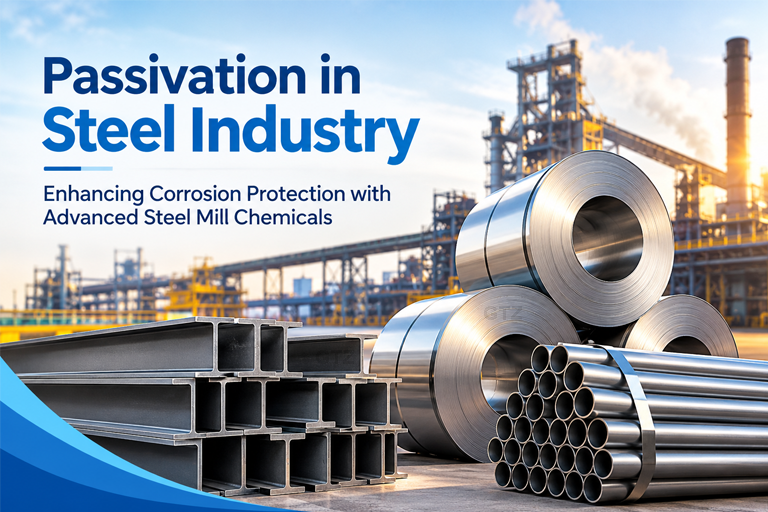
Passivation in Steel Mill Industries: Enhancing Corrosion Protection with Advanced Steel Mill Chemicals








Steel is the most widely used engineering materials globally. No matter wherever it is used in automobiles, construction, home appliances, electrical equipment, or industrial machinery, its performance depends not only on its mechanical properties but also on the quality of its surface protection.
Passivation is a critical surface treatment process in modern steel manufacturing, particularly for galvanized and zinc-coated steel products. While often carried out as the final stage of production, it plays a vital role in protecting surface quality and enhancing corrosion resistance throughout storage, transportation, fabrication, and end-use applications.
At GTZ (India) Pvt. Ltd., we understand the evolving needs of steel manufacturers and offer a comprehensive range of Passivation Chemicals under our Steel Mill Chemicals product group, designed to provide reliable corrosion protection for galvanized, galvalume, and zinc alloy coated steel strips. (GTZ India Pvt. Ltd.)
What is Passivation?
Passivation is a chemical surface treatment process that forms a thin, protective conversion coating on galvanized or zinc-coated steel. This protective layer minimizes the reaction between the metal surface and environmental contaminants such as moisture, oxygen, and salts.
The result is improved resistance to:
- White rust formation
- Storage stains
- Surface darkening
- Premature corrosion
- Handling and transportation damage
For steel manufacturers, passivation is not merely a finishing operation—it is an essential quality assurance process that enhances product durability and customer satisfaction. (GTZ India Pvt. Ltd.)
Why is Passivation Important in Steel Mills?
Freshly galvanized steel is highly susceptible to surface reactions. Without adequate surface treatment, exposure to moisture and humidity during storage or transportation can rapidly lead to white rust, staining, and deterioration of the surface appearance.
An effective passivation treatment provides several advantages:
- Improved corrosion resistance
- Longer storage life
- Better appearance of finished coils and sheets
- Reduced customer complaints
- Improved export quality
- Enhanced coating performance
- Lower rejection rates
- Higher customer confidence
These benefits make passivation a critical process for manufacturers supplying steel to demanding industries such as automotive, construction, electrical, appliance, and infrastructure.
Where is Passivation Used?
Passivation chemicals are widely used in:
- Continuous Galvanizing Lines (CGL)
- Galvalume Lines
- Colour Coating Lines (CCL)
- Steel Coil Processing Plants
- Galvanized Sheet Manufacturing Plants
- Structural Hot Dip Galvanizing
- Tin Plating line (ETL)
- Galvanneled Substrate
- ZAM Coated Sheet
GTZ’s Range of Passivation Chemicals
Recognizing that each steel processing line has different performance and environmental requirements, GTZ offers a wide portfolio of passivation technologies.
1. Hexavalent Chrome Passivation
CHEMIDITE 8-4
Designed for galvanized surfaces requiring excellent corrosion protection and a clear chromate finish.
Typical application:
- Galvanized steel strip
- Continuous galvanizing lines
- Structural hot dipping process
2. Mixed Chrome Passivation
GTZ offers multiple products under this category:
- CHEMIDITE 8-4J
- CHEMIDITE 8-4M
- CHEMIDITE 8-4B
- CHEMIDITE 4189E
- CHEMIDITE 4189C
These products contain carefully balanced both Hexa Chromium and Tri chromium chemistry to provide superior protection for galvanized and galvalume coated steel strips.
Key benefits include:
- Excellent resistance to white rust
- Uniform clear finish
- High bath stability
- Suitable for dip-squeeze, spray-squeeze, and roll coater applications. (GTZ India Pvt. Ltd.)
3. Mixed Chrome with Wax
For applications requiring additional lubrication and handling performance, GTZ offers:
- CHEMIDITE 4187W
- MSPWL (Wax Emulsion)
These products improve:
- Surface lubricity
- Coil handling
- Press forming performance
- Storage protection
- Fretting corrosion prevention
4. Trivalent Chrome Passivation
As industries move toward environmentally responsible solutions, GTZ provides advanced trivalent chrome technologies.
Products include:
- CHEMIDITE 8-33TCP
- CHEMIDITE 8-66TCP
- CHEMIDITE 8-65TCP
Advantages include:
- Excellent corrosion resistance
- Compliance with many modern environmental requirements
- Uniform appearance
- Improved process stability
5. Trivalent Chrome with Lubricant
CHEMIDITE 8-55TCP
Designed for customers requiring both corrosion protection and improved forming characteristics.
Suitable for:
- Automotive steel
- Appliance steel
- High-speed processing lines
- Fretting corrosion prevention
6. Chrome-Free Passivation
Many global manufacturers are transitioning toward chrome-free technologies.
GTZ offers:
- CHEMIDITE 9-1NCP
- CHEMIDITE 9-25NCP
- CHEMIDITE 9-79NCP
- CHEMIDITE 95PT
These inorganic – organic composite formulations provide:
- Excellent corrosion resistance
- Improved environmental compliance
- Uniform surface quality
- Protection for galvanized and galvannealed steel strips. (GTZ India Pvt. Ltd.)
7. Chrome-Free Passivation with Lubricant
CHEMIDITE 9-66NCP
This advanced formulation combines chrome-free corrosion protection with a low coefficient of friction (COF), making it ideal for applications requiring smooth downstream processing.
Benefits include:
- Reduced friction
- Better forming performance
- Improved coil handling
- Enhanced corrosion protection
- Inhibit fretting corrosion
Selecting the Right Passivation Chemical
Choosing the correct passivation chemistry depends on several factors, including:
- Steel grade
- Coating type
- End-use application
- Export or domestic market
- Environmental regulations
- Customer specifications
- Required corrosion resistance
- Line speed and processing conditions
An optimized passivation process not only improves product performance but also helps reduce maintenance costs and increase production efficiency.
Why Steel Manufacturers Choose GTZ
GTZ has been serving the metal finishing and steel industries for decades by delivering high-performance specialty chemicals backed by technical expertise.
Our Steel Mill Chemicals portfolio includes:
- Alkaline Cleaners
- Roll Cleaners
- Spray & Immersion Cleaners
- Pickling Inhibitors
- Galvanizing Flux
- Passivation Chemicals
- Thin Organic Coatings (TOC)
- Colour Coating Line Chemicals
- Stainless Steel Finishing Chemicals
This integrated product range enables steel manufacturers to source multiple process chemicals from a single trusted partner. (GTZ India Pvt. Ltd.)
Conclusion
Passivation is not merely a finishing step—it is a strategic process that safeguards product quality, strengthens corrosion protection, and enhances customer satisfaction.
As steel manufacturers continue to meet higher quality standards and strict environmental requirements, selecting the right passivation chemistry becomes increasingly important. Whether the operation requires conventional chromate systems, advanced trivalent chrome technology, or environmentally friendly chrome-free solutions, GTZ offers a comprehensive portfolio to meet diverse production needs.
With decades of expertise in specialty chemicals, GTZ continues to support steel manufacturers with innovative, reliable, and performance-driven solutions that improve operational efficiency and enhance the long-term value of every steel product.
Explore GTZ’s Steel Mill Chemicals portfolio to discover passivation solutions tailored to your production requirements and corrosion protection goals.

- Electroless vs Electrolytic Nickel Plating: Key Differences - October 23, 2026
- Passivation in Steel Mill Industries: Enhancing Corrosion Protection with Advanced Steel Mill Chemicals - October 23, 2026
- Pickling in Steel Mill Industries: Maximizing Surface Quality with Advanced Pickling Inhibitors - October 22, 2026