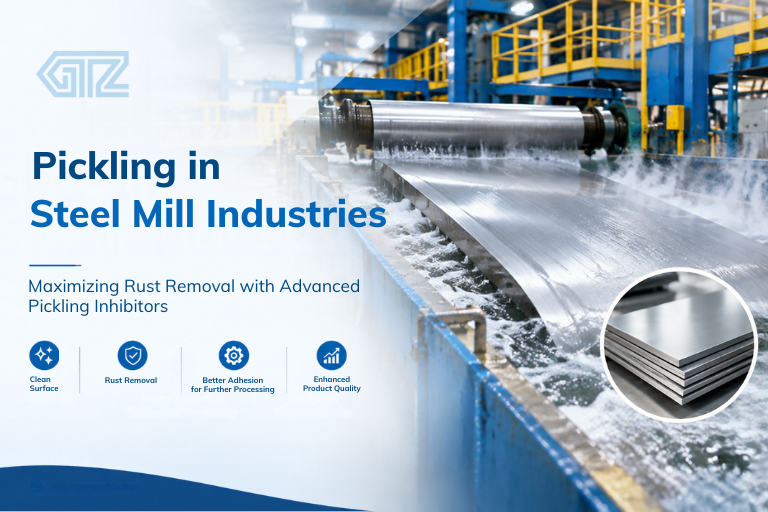
Pickling in Steel Mill Industries: Maximizing Surface Quality with Advanced Pickling Inhibitors








In today’s steel industry, producing clean, defect-free steel surfaces is essential for manufacturing high-quality products. Whether the steel is destined for automotive components, galvanized sheets, home appliances, construction materials, or engineering applications, the surface preparation process determines the quality of every downstream operation.
One of the most critical stages in steel processing is pickling. While the process effectively removes mill scale and rust, improper pickling can result in excessive metal loss, higher acid consumption, equipment corrosion, and increased production costs.
This is why modern steel mills rely on pickling inhibitors—specialized chemicals that improve pickling efficiency while protecting both the steel and the pickling system.
At GTZ (India) Pvt. Ltd., our Steel Mill Chemicals portfolio includes advanced CORONIB Pickling Inhibitors, developed to deliver efficient oxide removal, lower operating costs, and superior surface quality for steel manufacturers. (GTZ India Pvt. Ltd.)
What is Pickling?
Pickling is a chemical cleaning process in which steel is treated with mineral acids—most commonly hydrochloric acid (HCl)—to remove:
- Mill scale
- Iron oxides
- Rust
- Heat treatment scale
- Surface contamination
The result is a bright, clean metallic surface that is ready for further processing such as:
- Cold rolling
- Galvanizing
- Annealing
- Painting
- Colour coating
- Electroplating
Without proper pickling, downstream coating adhesion, product appearance, and corrosion resistance can be significantly affected.
The Challenge of Acid Pickling
Although hydrochloric acid efficiently removes oxide layers, it also attacks the base steel.
Without an effective inhibitor, steel mills may experience:
- Excessive metal loss
- Over-pickling
- Increased acid consumption
- Hydrogen embrittlement
- Equipment corrosion
- Higher maintenance costs
- Poor surface finish
- Reduced bath life
These challenges increase production costs while reducing product quality.
What is a Pickling Inhibitor?
A pickling inhibitor is a specially formulated chemical additive that controls the reaction between the acid and the base metal.
Rather than slowing the removal of mill scale, the inhibitor selectively protects the steel once the oxide layer has been removed. This allows the acid to continue dissolving scale while minimizing unnecessary attack on the steel substrate.
The benefits include:
- Lower metal loss
- Reduced acid consumption
- Improved pickled surface finish
- Protection against over-pickling
- Longer bath life
- Better process control
- Lower operating costs
Benefits of Using Pickling Inhibitors
Modern pickling inhibitors provide significant operational advantages.
Improved Surface Quality
A controlled pickling process produces a cleaner and more uniform steel surface, resulting in better coating adhesion and higher-quality finished products.
Reduced Acid Consumption
By minimizing unnecessary acid attack on the steel, inhibitors help extend bath life and reduce chemical costs.
Lower Metal Loss
Steel weight loss during pickling is significantly reduced, improving production yield and material utilization.
Protection Against Hydrogen Embrittlement
Quality inhibitors reduce excessive hydrogen evolution during pickling, helping protect steel properties in critical applications.
Equipment Protection
Pickling inhibitors also reduce corrosion of tanks, pumps, piping, and associated process equipment, contributing to longer equipment life and lower maintenance costs.
GTZ Pickling Inhibitor Range
GTZ offers a specialized range of hydrochloric acid pickling inhibitors under the CORONIB series.
CORONIB 121B / CORONIB 114
An advanced inhibitor developed for hydrochloric acid pickling applications.
Key Features
- Excellent metal protection
- Reduces acid attack on mild steel
- Improves surface finish
- Suitable for continuous and batch pickling operations
- Helps improve process efficiency
CORONIB 18
A high-efficiency hydrochloric acid pickling inhibitor designed for demanding steel processing applications.
Benefits
- Controls over-pickling
- Reduces steel loss
- Improves bath performance
- Supports consistent production quality
- Suitable for high-speed steel processing lines
CORONIB 18F / CORONIB 17 / CORONIB 1255F / CORONIB 17V
An advanced pickling inhibitor with foam blanket technology.
Advantages
- High pickling efficiency
- Foam layer helps suppress acid fumes
- Improved operator safety and working environment
- Better acid utilization
- Enhanced bath stability
Advanced Pickling Technology: CORONIB 123U / CORONIB 121 / CORONIB 121T / CORONIB 121A
For steel mills seeking enhanced performance, GTZ also offers CORONIB 123U, a hydrochloric acid pickling inhibitor formulated for continuous and batch strip pickling operations.
Its key advantages include:
- Prevents over-pickling and reduces steel loss
- Compatible with Acid Regeneration Plants (ARP)
- Maintains pickling speed without slowing production
- Provides better rinsing characteristics
- Minimizes hydrogen embrittlement
- Effective across a wide operating temperature range
- Free from nitrates, chromates, and fluorides
- Helps protect pickling equipment while producing a clean, high-quality steel surface. (GTZ India Pvt. Ltd.)
Applications
GTZ Pickling Inhibitors are suitable for:
- Continuous Pickling Lines (CPL)
- Hot Rolled Coil Processing
- Cold Rolling Mills
- Galvanizing Lines
- Steel Service Centres
- Coil Processing Plants
- Batch Pickling Operations
- Tube and Pipe Manufacturing
- Wire Rod Processing
Why Steel Mills Choose GTZ
GTZ has decades of experience in supplying specialty process chemicals to the steel industry.
Our Steel Mill Chemicals portfolio includes:
- Alkaline Cleaners
- Roll Cleaners
- Spray & Immersion Cleaners
- Cleaning Boosters
- Defoamers
- Pickling Inhibitors
- Galvanizing Flux
- Passivation Chemicals
- Thin Organic Coatings (TOC)
- Colour Coating Line Chemicals
- Stainless Steel Finishing Chemicals
This integrated product range enables steel manufacturers to optimize every stage of surface preparation and corrosion protection using a single, trusted technology partner. (GTZ India Pvt. Ltd.)
Conclusion
Pickling is far more than an acid cleaning operation—it is a critical process that influences the quality, performance, and value of every finished steel product.
By incorporating advanced pickling inhibitors, steel manufacturers can reduce acid consumption, minimize metal loss, improve surface quality, extend equipment life, and achieve more consistent production results.
GTZ’s CORONIB range of pickling inhibitors is designed to help steel mills maximize productivity while delivering cleaner surfaces, improved corrosion performance, and lower overall operating costs.
Whether you operate a continuous pickling line, a galvanizing plant, or a coil processing facility, GTZ offers reliable chemical solutions backed by technical expertise to support efficient and sustainable steel manufacturing.

- Electroless vs Electrolytic Nickel Plating: Key Differences - October 23, 2026
- Passivation in Steel Mill Industries: Enhancing Corrosion Protection with Advanced Steel Mill Chemicals - October 23, 2026
- Pickling in Steel Mill Industries: Maximizing Surface Quality with Advanced Pickling Inhibitors - October 22, 2026